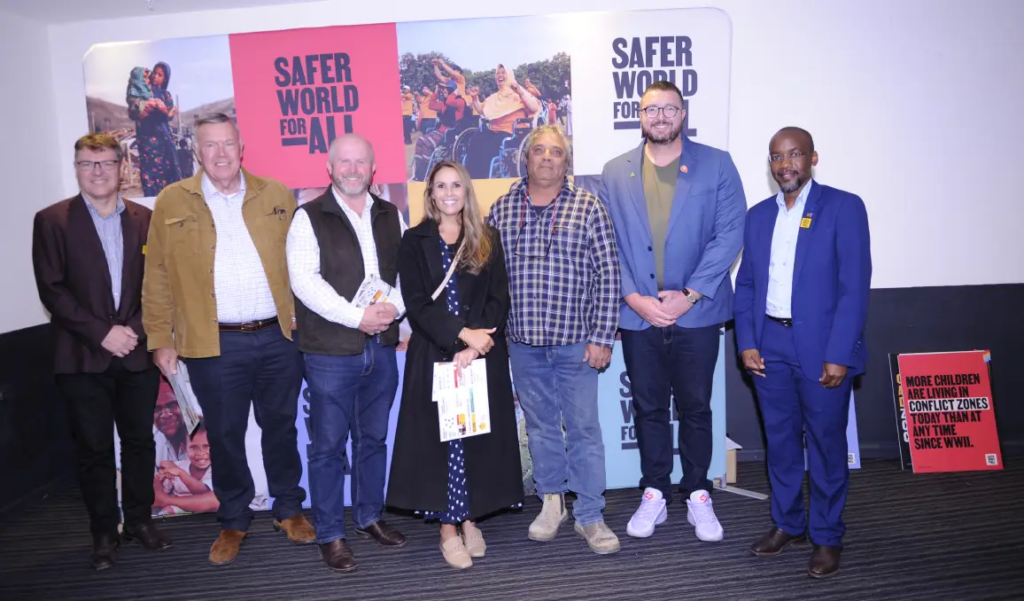
Australian Lutheran World Service executive director Michael Stolz (left) and Albury Wodonga Ethnic Communities Council community executive officer Richard Ogetii (right) joined Farrer byelection candidates David Farley (One Nation), Brad Robertson (Nationals), Raissa Butkowski (Liberal), Gary Pappin (independent) and Richard Hendrie (Greens).
by Richard Ogetii & Michael Stolz
Originally published – 3 May, 2026
On a cool evening in Albury last week, something quietly remarkable happened.
In a time when public life often feels polarised and combative, candidates from across the political spectrum – One Nation, Liberal, National, Greens and independents – sat in the same room, not to debate, but to listen.
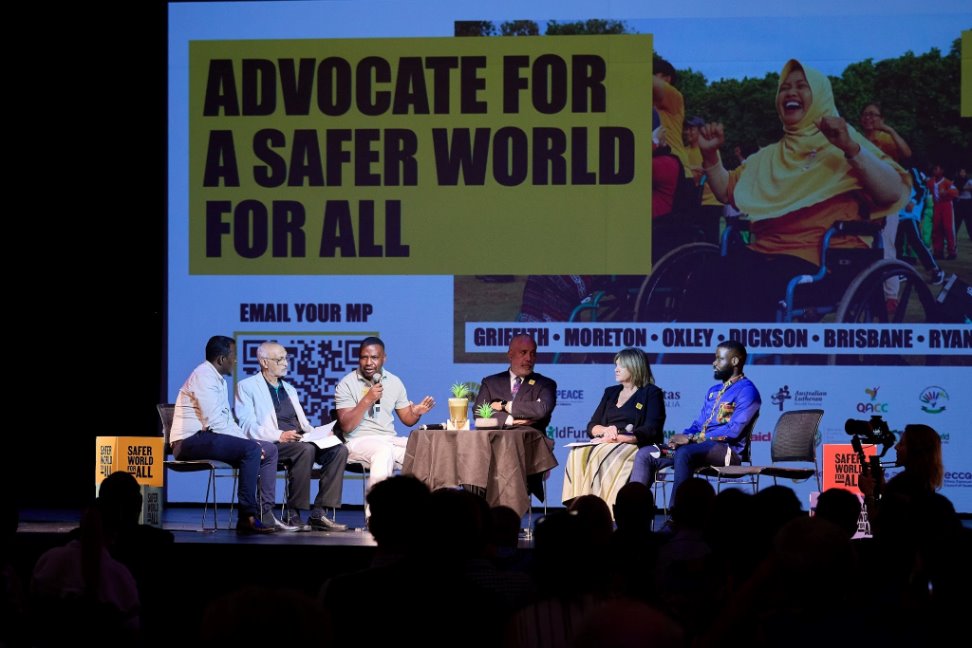
Around them were members of our region’s diaspora and faith communities, alongside long-time locals, all gathered for the Safer World for All community forum in partnership with the Albury Wodonga Ethnic Communities Council and Australian Lutheran World Service.
There were no slogans thrown, no points scored. Instead, there was something far more powerful: a shared recognition that what happens beyond our borders matters deeply to people here in Farrer.
That might surprise some. This is, after all, a region known for its farms, its small businesses and its tight-knit communities, not for foreign policy debates. But as Richard reminded the room, we live in a world where “what happens far away does not stay far away.” It shapes the lives of families we are connected to, the security of our region, and the future of our children.
For many in the audience, this isn’t an abstract idea. It is lived experience. People spoke not just as voters, but as people who have fled conflict, supported family members through hardship overseas, or rebuilt their lives here in Australia.
Their stories grounded the conversation in a simple truth: global instability is personal. And here in Farrer, that understanding runs deeper than we might realise. Just down the road from Albury lies Bonegilla, the former migrant reception centre that welcomed more than 300,000 people after the Second World War.
One Nation candidate for Farrer David Farley says net overseas migration of 306,000 is “not too many”.
Migration part of our story
It is part of our national story, but it is also profoundly local. Families arrived with little more than hope, stepping into harsh conditions and uncertainty, wondering whether this new country would live up to its promise. What they found, over time, was community. They found people who showed up.
People like Lutheran pastor Bruno Muetzelfeldt, who saw arrivers not as strangers, but as people like himself, people in need of support to rebuild. From those early acts of practical compassion grew Australian Lutheran World Service (ALWS), an organisation that still calls Albury home more than seven decades on.
There is something profoundly fitting about that. Because ALWS reflects a value set many in our region instinctively understand: when people are given the chance to rebuild, it doesn’t just change their future, it strengthens ours. That was the thread connecting history to the present at the forum.
Farrer byelection candidates attend the Safer World for All community forum held in Albury by Albury Wodonga Ethnic Communities Council and Australian Lutheran World Service.
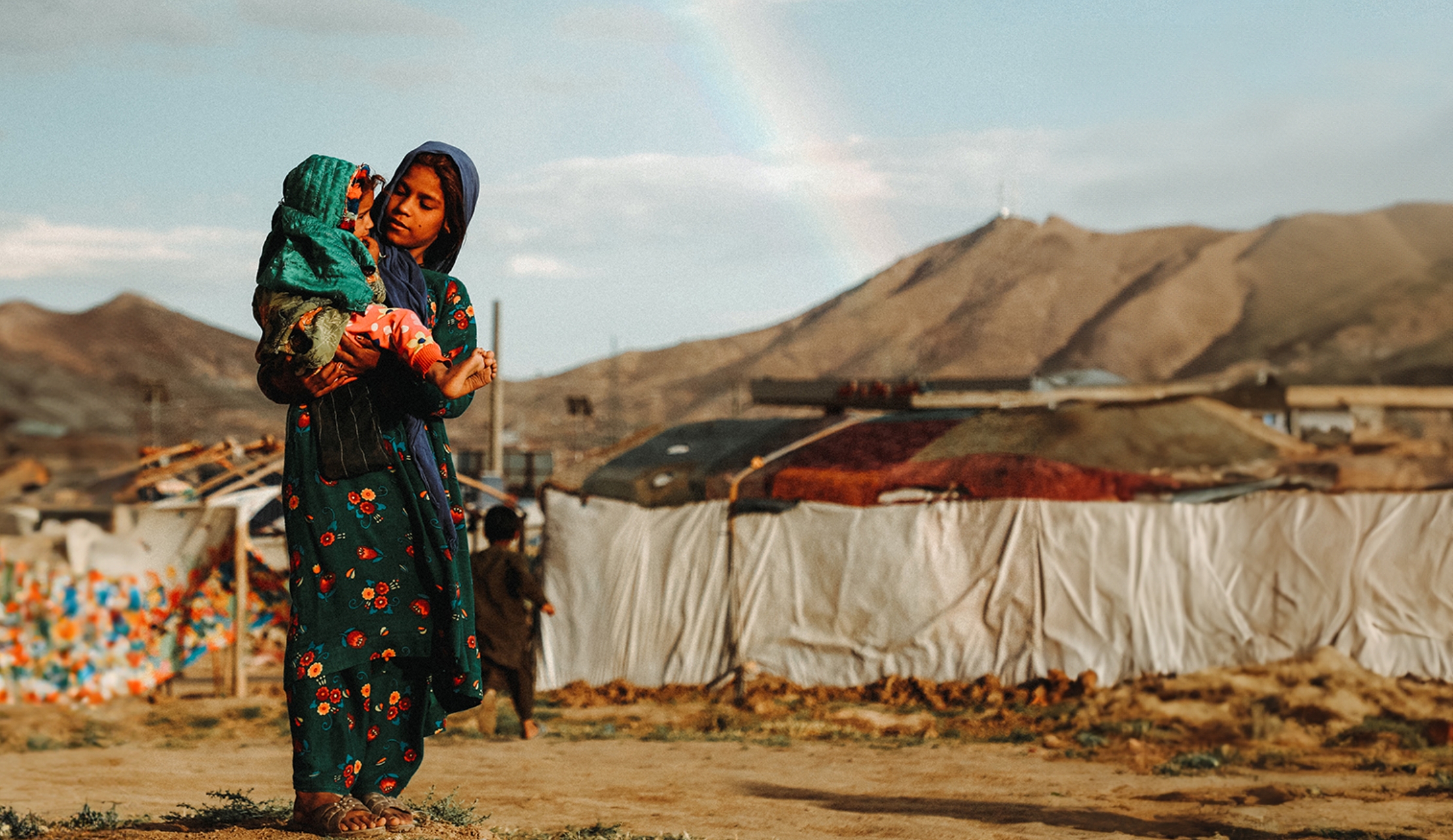
Today, the same forces that drove people to Bonegilla – conflict, poverty, displacement and instability – continue to shape lives across the world. Families are still leaving their homes not out of choice, but necessity. They are still seeking dignity, safety and a future for their children.
And just as in the past, the question for us is how we respond. What made the evening so striking was that this question did not divide the room, it united it. Candidates with very different political platforms sat side by side, listening to stories of hardship and resilience. They heard why aid and development programs matter, not as abstract line items in a federal budget, but as tools that help prevent conflict, support stability and create safer societies.
One speaker captured it powerfully: security is not something we can build for ourselves alone. When instability goes unaddressed, it spreads. But when we invest in stability elsewhere, “security for them becomes security for us”.

Shared interests and shared humanity
This is not about charity. It is about shared interests and shared humanity. For a region like Farrer, with its strong agricultural base, that idea resonates. Farmers here understand risk. They understand what it means to rebuild after loss. They understand that you cannot control everything, but you can choose how you respond.
That same mindset underpins effective international development: practical support, long-term thinking, and a commitment to helping people stand on their own feet. Yet Australia’s aid investment remains modest compared to other developed nations, even as global instability grows. That gap between our generosity as individuals and our choices as a nation was a pointed theme of the evening.
But what lingered most was not critique, it was possibility. Because for a few hours in Albury, the usual divides softened. People listened across differences. Candidates engaged with community voices not as opponents, but as representatives of a shared electorate.
It was a reminder that, even in a contested byelection, there is space for common ground. And perhaps that is the real lesson of the night. Farrer is not disconnected from the world. It never has been. From Bonegilla to today’s vibrant multicultural communities, our region has long been shaped by global currents and by the choices we make in response to them.
The Safer World for All forum showed that when we create space for listening, for story, and for shared purpose, those choices can bring us together rather than pull us apart.
In a world that often feels divided, that is no small thing. Because building a safer world is not just something that happens in Canberra, or at international summits. It starts in places like Albury, where community members gather, where leaders listen, and where we are reminded that the future we want here at home is tied, inextricably, to the future we help build beyond our shores.
Richard Ogetii is the community executive officer at the Albury Wodonga Ethnic Communities Council
Michael Stolz is the executive director of Australian Lutheran World Service